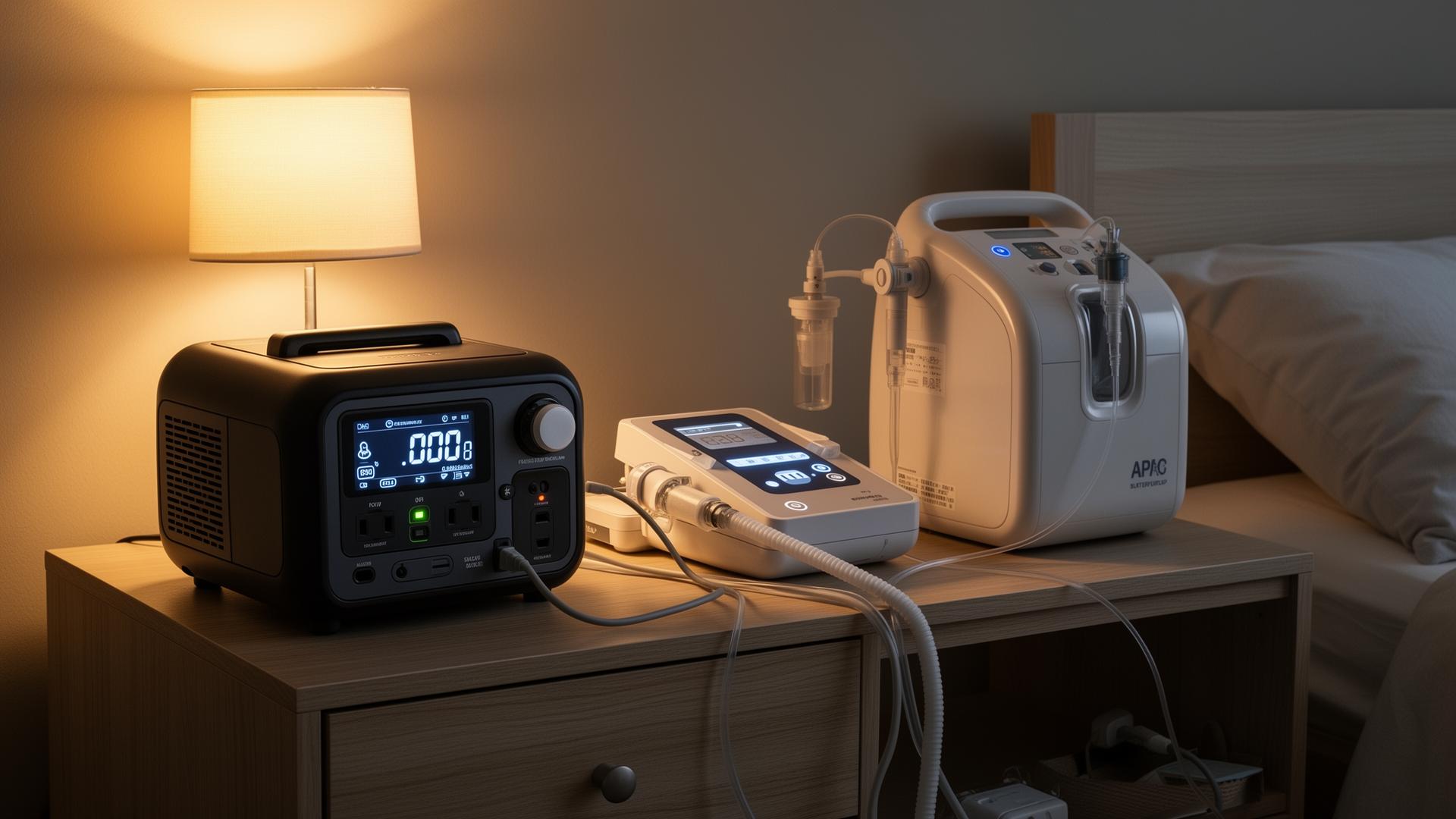
If you rely on a CPAP, a power outage isn't an inconvenience - it's a safety issue. The good news: CPAP machines are one of the easiest medical devices to back up with a portable power station. The bad news: most guides ignore how much a heated humidifier changes the math.
The short answer:
- A CPAP without humidifier: 500Wh station = 1 full night, easily
- CPAP + humidifier: 1,000Wh station = 1-2 nights
- CPAP + humidifier + heated hose: 2,000Wh station = 2-3 nights safely
- Use the DC output cable if available - it skips the inverter and adds ~20% runtime
Why the humidifier changes everything
The CPAP blower motor itself is tiny - it usually pulls 20-40W depending on pressure setting. That's less than a laptop charger. You could run one from a portable power station for days.
The heated humidifier is a different animal. It's a resistive heater, and heaters are always the biggest draw in any electrical system. On a warm setting it can double your CPAP's wattage. Add a heated hose and you're pushing 100W - three or four times the base draw.
CPAP wattage by setup
These are averages across common ResMed, Philips, and Fisher & Paykel machines running an 8-hour night:
| Setup | Draw | Per Night | Verdict |
|---|---|---|---|
| CPAP only, no humidifier, no heated hose | 25 - 40 W | ~240 Wh | Very easy |
| CPAP + heated humidifier (warm setting) | 50 - 70 W | ~480 Wh | Standard |
| CPAP + heated humidifier + heated hose | 75 - 100 W | ~700 Wh | Bigger battery needed |
| BiPAP / APAP with full heat | 95 - 130 W | ~900 Wh | Plan for 1,500Wh+ |
CPAP Overnight Runtime Calculator
See how many nights your power station can safely run your CPAP
Nightly draw: 480Wh (60W x 8h)
Using the DC output cable instead of the AC inverter typically adds 15-25% more runtime by skipping the inverter loss.
Assumes 85% AC inverter efficiency and 92% DC efficiency. Turn the humidifier off overnight to nearly double runtime.
What size power station do I need?
Match the battery to how many nights you actually need to survive an outage.
One-night insurance (single outage)
500-1,000Wh. Handles CPAP + light humidifier for a full 8 hours. Cheapest reliable option.
Weekend outage (2-3 nights)
1,500-2,000Wh. Comfortable with humidifier. Recharges quickly when power returns. The sweet spot for most CPAP users.
Multi-day / hurricane (4+ nights)
2,000Wh+ plus a solar panel. With daytime solar, you can run CPAP indefinitely. This is the setup we recommend for anyone with a serious sleep apnea diagnosis.
Recommended power stations for CPAP backup
These stations pair well with CPAP use - clean AC output, DC options where available, and enough capacity for real multi-night use:
1,264Wh, quiet operation, and a 12V DC output that some CPAP DC cables plug into directly. Great one-to-two night backup.
2,048Wh with fast recharging and solid pure sine wave AC. Runs a full CPAP + humidifier setup for 2-3 nights.
2,048Wh with expandable capacity. Pair with a 200W solar panel for indefinite off-grid CPAP use.
6 ways to stretch your CPAP battery
Use the DC output cable if your CPAP supports it - skipping the AC inverter saves 15-25% per night
Turn off the heated humidifier during outages - the single biggest wattage saver you have
If you keep the humidifier on, drop it to the lowest heat setting to roughly halve the draw
Turn off the heated hose - it's a comfort feature, not a therapy requirement
Keep the CPAP filter clean - a clogged filter forces the blower to work harder and draw more power
Charge from solar during the day, run CPAP at night - the standard off-grid pattern that runs forever
Quick FAQs
Can a portable power station really run a CPAP all night?
Yes, easily. A CPAP without a humidifier averages 30-40W. Even a modest 500Wh station runs it comfortably for a full 8-hour night. The complication is heated humidifiers and heated hoses, which can triple the draw.
Do I need a pure sine wave power station for a CPAP?
Yes. CPAP motors and internal electronics expect clean AC. Every power station we recommend outputs pure sine wave, so this is only a warning for cheap car inverters. Better yet, use the DC output cable if your CPAP supports it - it skips the inverter entirely.
Should I turn off the humidifier to save battery?
For emergency backup, yes. The heater is the single biggest draw in your CPAP setup. Running dry for a night or two is uncomfortable but safe. If comfort matters, drop the heat setting to the lowest level - you'll roughly halve the draw.
Can I recharge the power station overnight while it runs the CPAP?
Yes, most modern stations support pass-through charging. If you have solar panels or grid power available part of the night, you can run indefinitely. Solar during the day + battery at night is the standard off-grid CPAP setup.
Is it safe to use a portable power station for a medical device?
Reputable stations from EcoFlow, BLUETTI, Jackery, and Anker are safe for CPAP use - they output clean AC and have overload protection. That said, they are not FDA-classified medical equipment. If you rely on a CPAP for a serious condition, always keep a backup plan and consult your provider.
One honest safety note
Portable power stations are excellent CPAP backups, but they are not medical-grade devices. If your sleep apnea is severe, keep a second backup plan (a smaller CPAP battery, a car inverter, or a nearby friend's house) in case anything fails. Redundancy is the whole point.